Sunday, January 26, 2014

It's A Small World

It's still amazing to me how the world wide web has made the world shrink. Last week I received an e-mail from Stuttgart, Germany.


my Name is Bernd. I`m 51 years old and live in Germany near Stuttgart. I am mechanical engineer and reserve officer.
My friend Rolf grew up in a small village in the south of Stuttgart. A few years ago he told me about a crashsite of a bomber in the SCHOENBUCH forest northern TUEBINGEN.  At the place in the forest I sew no parts of a plane.
Rolf told me, that when he was a boy, big parts of a plane lay there. In the late sixties the last parts were scrapped. Body and wings were scrapped in war. His grandfather found a type plate on a motorpart. BRISTOL Hercules. a radial motor.  At the moment the plate is lost in Rolfs cellar -
We searched  surface of the place and found small alluminum parts of a crashed british plane: I found a .303 case with headstamp dated 1943.  Rest of a 4 lbs incendiary bomb. Then I found the most important artifact: a part of a fuel tank gauge. 1-114 GALLONS with a Serial number. I started a investigation and the result: this Instrument was only used in LANCASTER Bombers in the flight engineer`s panel.

LANCASTER  with  BRISTOL Hercules radial motors? I never heard or read before.
The LANCASTER BII Version used by RCAF was right.
I searched for all planes of this version,  lost on raids  to STUTTGART in 1943 or later, with unkown crashsites. I found only 3 airplanes. One crashed in France on it`s way back, the second was downed by a nightfighter near the STUTTGART Airport.

Only your father`s  LANCASTER DS829 remained.

At 15/16th March 1944  863!" bombers started to STUTTGART.  From England they fley to the LAKE CONSTANCE then turned left to the north direction STUTTGART.  The crashsite is about 25 miles south of the target. Do you know where your father bailed out?


I replied that Dad remembered bailing out into the Black Forest.

hanks for the Information.  In my opinion  your Dad remembered right, because the Black Forest is near to the crashsite. No problem for a falling plane.


Monday, November 11, 2013

Veterans' Day 20013

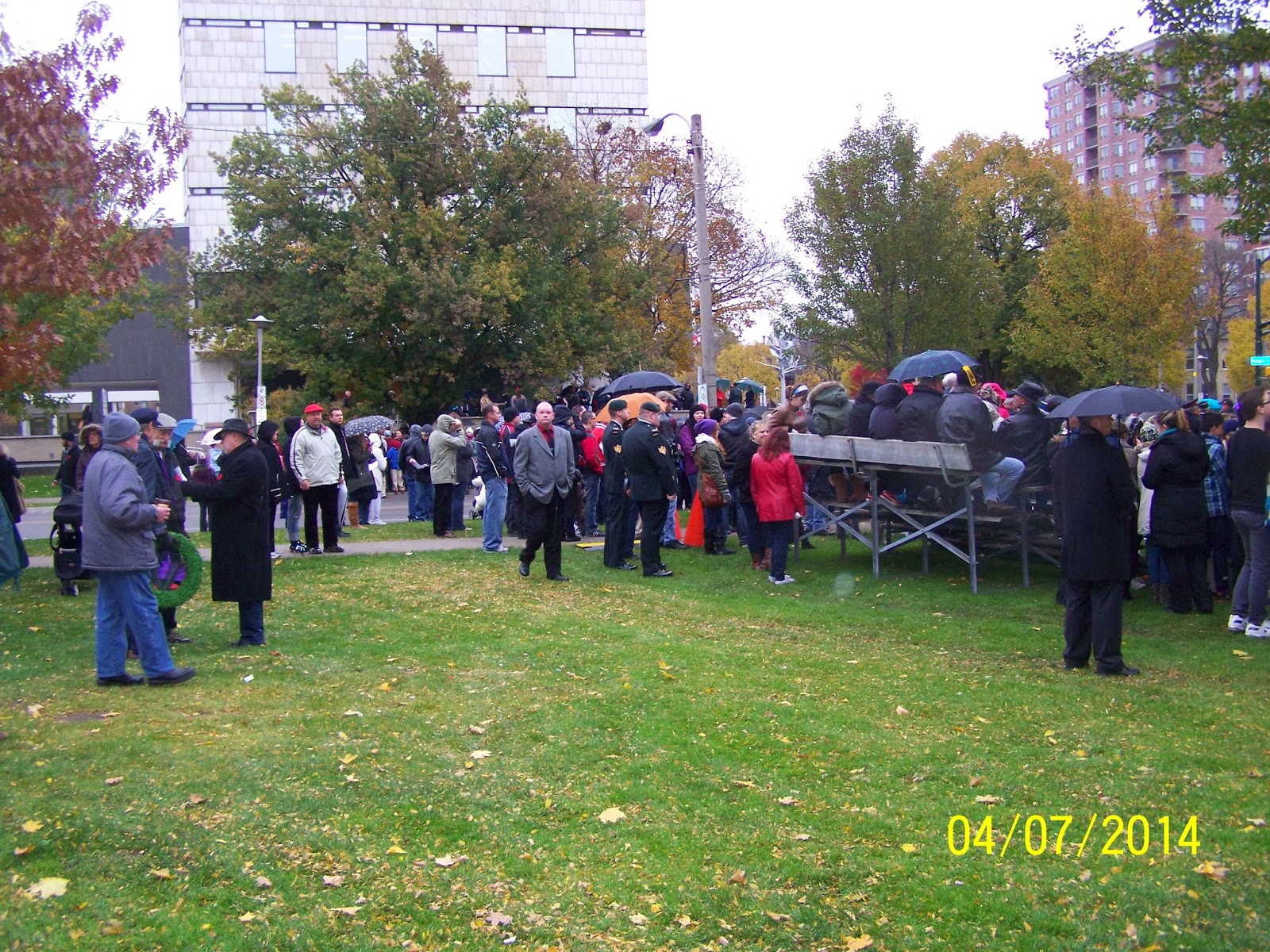
It was cold and wet on this Veterans' Day in London, Ontario. All the same the turnout seemed to be in the hundreds.


Sunday, November 3, 2013

The following article that appeared in the London Free Press outlines a decision on what to do with Great War memorabilia. I found it to be very encouraging. I myself wrestled with what to do with my father's Second World war medals, and effects, several years ago. The proper decision I felt then, and still feel, was to donate the items to the Elgin County Military Museum.

Friday, May 17, 2013

Head Of Library And Archives Canada Resigns


Daniel Caron, the Library and Archives boss has resigned. I expect that there was a collective sigh from the archival, and librarian community. He seems to have managed to alienate just about everyone.


It remains to be seen who the Conservative Government will put in his place. I wouldn't hold my breath. The Conservative Government so far have shown a remarkable ability to use our own history for its propaganda value while at the same time emasculating the Archives.


In my view the basic problem is very much a Canadian one. That is to say too much geography, and not enough people. For me to get to the National Archives means a day of traveling, and expensive hotels.
What has hit me hardest is the cutback to the inter-library loan program. It left me wondering if the National Archives was indeed national, or merely an Ottawa institution?


Tuesday, July 10, 2012

Twentieth Century Meets The Nineteenth

Sometimes on a research trip (in this case the First Division in 1914) you come upon a little unexpected gem. I was basically looking at newspaper photo's, when I came upon one of the Bengal Lancers taken in Belgium in August of 1914. I wonder how useful those lances would be against machineguns? Mind you, some generals never did work that one out.
"The London Advertiser", August 29, 1914.

Wednesday, June 20, 2012

Officers of the 7th. Fusiliers Who Volunteered in 1914

It will take a while to go through the list of the men who volunteered, and were accepted, for the Canadian Expeditionary Force in 1914. We will start with the officers.

From left to right- William John Taylor, Francis Bethel Ware, Henry Campbell Becher, Walter Chester Butler. The London Advance 22 August, 1914.

Henry Campbell Becher
In 1914 Lt. Colonel in command of the 7th. Fusiliers. Born 20 January 1874 in London, Ontario, and died 15 June 1915.
 
William John Taylor

In 1914 Captain in the 7th. Fusiliers. Born 29 January 1872 in Cayuga, Ontario. His attestation papers show a transfer to the Royal Highlanders of Canada. He seems to have survived the war but more research is needed to find out where he served.

Francis Bethel Ware

In 1914 Captain in the 7th. Fusiliers. Born 29 January 1877 in London, Ontario. At Valcartier he was made a staff officer, and served in that capacity throughout the war. Later he became commanding officer of the 7th. Fusiliers. His book “The Story of the Seventh Regiment, Fusiliers of London, Canada 1899 to 1914” (London, 1945) is one of the few histories available on the regiment.

George Boyd Watson

In 1914 Captain in the 7th. Fusiliers. His attestation papers give his birth date as 1914. Pretty much an impossibility. In the 1911 Canada Census his birthday is given as 12 October 1877 in London, Ontario.

Gordon Cecil Hunt

In 1914 Captain in the 7th. Fusiliers. Born 11 October 1884 in London, Ontario.

Walter Chester Butler

In 1914 Lieutenant in the 7th. Fusiliers. Born 10 September 1886 in London, Ontario. He was wounded in 1915. He returned to England where he was posted to Canadian Headquarters in London for the remainder of the war.

Archibald Hendry Galbraith

In 1914 Lieutenant in the 7th. Fusiliers. Born 6 January 1871 in Southampton, England. The only officer in this list who was born outside of Canada.


According to Francis Ware’s book the only officer still actively serving on the Western Front by November 11, 1918 was himself.

Thursday, June 7, 2012

Telegram To The 7th. Fusiliers August 1914

I have been spending some time researching the 7th. Fusiliers. In the next few posts I will outline some of what I have found about the men from this regiment. With an emphasis on those who volunteered to serve in the Great War.

This is the first time that I have actually seen the telegram (mentioned in most of the books on the Canadian Corps) sent out by Sir Sam Hughes to commanders of the regional militia regiments. Hughes consigned a controlled, planned mobilization schedule to the trash, and embraced chaos. As Tim Cook wrote: ‘Hughes sent out 226 telegrams to militia commanders across the country…It was, in his words, “a call to arms, like the fiery cross passing through the highlands of Scotland or the mountains of Ireland in Former days.”’ (1)

August 6/14 C.P. Night Lettergram

Lt. Col. H.C. Becher

Regulations to govern raising of a contingent for overseas service will be as follows. stop the force will be imperial and have the status of British regular troops. stop enrollment will be voluntary for all ranks stop physical qualifications will be as follows stop 5 feet 3 inches and stop chest not less than 33 ½ stop the age limit will be 18-45 years. stop in regard to musketry and general proficiency a high standard will be required stop the term of service will be for the duration of the war stop other considerations being equal applicants will be selected on the following order stop unmarried men stop married men without families stop married men with families stop officers on the reserve and others with military experience who although not belonging to the active militia fulfil the foregoing requirements are eligible stop the senior officers of units will through officers commanding companies etc. collect the names of volunteers officers non-commissioned officers and men who should be medically examined by an army medical officer where available stop when all the names have been received officers commanding units will submit direct to militia headquarters descriptive rolls of those who have passed the required medical examinations stop after rolls have been received the quota to be found by each unit will be determined and commanding officers will be given instructions as the numbers required from their respective units stop the individuality of each unit will be preserved as far as possible stop rolls to be prepared without delay so as to reach militia headquarters not later than Wednesday 12th instant stop the intention is to mobilize a contingent at Valcartier P.Q. where to secure the selection of the fittest stop more men will be assembled than in the first instance will be required to embark stop Acknowledge receipt by wire stop


Adjutant General

8 August 1914 (2)

(1) Tim Cook, “At The Sharp End: Canadians Fighting the Great War, 1914-1916”, Vol.1, Penguin Canada 2007, p.33

(2) J.J. Tallman Regional Collection at the University of Western Ontario Archives in London. 

Friday, March 2, 2012

One Tough Quizz

Today I found a history quiz on the “History Today” blog. I got 7 out of 10. Son of a gun ! Why don’t you give it a try ?

Thursday, February 16, 2012

World War One German Trench Found Intact

Many thanks to Jeff Booth of the Elgin County Military Museum for e-mailing me this interesting article. Archeologists have found an intact German trench from 1918 in Eastern France.

Wednesday, February 15, 2012

7th. Fusiliers 1899

There is a wealth of information in a book by Col. Francis R Ware, “The Story of the Seventh Regiment, Fusiliers of London, Canada 1899 to 1914”, Hunter Printing Company, 1945. Below I have listed some members of the regiment listed in the book for 1899.

Fred St. Clair Fisher

George Alexander Macbeth
Served in South Africa as a member of the Royal Canadian Regiment.
George Hayman
Became Mayor of London, Ontario for the year of 1931. He died in London, Ontario, October 22, 1943.(1)

Earl Mark Insley
Transfered to the 26th. Middlesex Regiment, and then went oveseas to the 135th. Battalion as a Captain and Quartermaster.

Alexander George Fraser
Went overseas with the 142nd. Battalion (London's Own), and served with the 1st. Battalion until wounded.

Henry Linton Milligan
During World War One he was promoted to Lt. Colonel and was one of the commanders of the 18th. Battalion. He died in London on July 1, 1941.

From his obit. "The London Free Press", July 2, 1941..

Alexander Ralph Skelton

Harry Wooster
His son Harry Wellington Wooster served overseas wit the 116th. Battalion. Harry Jr. went on to become the leader of the Vimy Orchestra in the next war.

Guy (Gaeterio) Lombardo
Father of Guy Lombardo band leader of the Royal Canadians.


Wednesday, February 8, 2012

It's In The Shoebox

It's amazing what you can find when you open the old shoebox rather than throwing it out. In one I found a cloth map of France, Germany, and Poland. It seems to be made of linen or cotton. My guess would be linen. I do not know how Dad got the map or even if he used it. From the condition of the map I doubt if it was used. But it was carefully folded and put into a shoebox for storage. Parts of the map are shown below.
Front of map showing Northern France
Also the front.
Back of map showing Germany and Poland.

Sunday, January 8, 2012

Researching The Oxford Rifles

Occasionally I receive requests for information such as the one below. I thought that I would outline how I would go about researching a military ancestor, or for that matter a military unit. I am a historian with a strong interest in genealogy, not the other way around, so my methods might well be a little different that that used by others.


“As I have been researching my great grandfather Vernon Graham I came across your site. He was in the Oxford Rifles abt 1865-66 and I think must have been part of the Fenian Raids. Could you please direct me as to where I would go to get records.? He is also listed as to being in the Woodstock Volunteer Rifles under Col Light. Your help would be much appreciated”

Oxford County volunteer militias date back to 1798. The Oxford Rifles were organized on 14 August 1863 by amalgamating the existing independent militia companies. The regiment did serve in the Niagara during the Fenian Raids, but arrived too late to participate in the Battle of Ridgeway.

I suspect from the little information I have that Vernon Graham was from Woodstock (I have been proven wrong before; however, most of the companies of any militia regiment are based on other towns or villages in the county). The first place that I would go to is the 1861 Canada Census to verify that Woodstock was indeed his home city. Here Ancestry.com is useful if you have access to the Library edition as it is free to use. If not the local library should have microfilm copies of the Canada Census’s.


The next step is to find copies of the pay books of the Oxford Rifles. For this period there is no equivalent of the World War One battalion diaries. Here a visit to the Woodstock City Museum might well pay off. They should have a copy of “Pay list of Oxford Rifles Militia 1865-1868: & record of officers 1907-1927”, Ontario Genealogical Society, Oxford County Branch, 1980. If you have no luck here then Library and Archives Canada have microfilmed “Nominal Rolls and paylists for the Volunteer Militia-22nd. Regiment, Oxford rifles”, Microfilm reel T-16577. I have not yet seen this microfilm so I can not attest as to what information is there. In any paylists the most you can expect is a list of names with pay and signatures. However, those who were involved in the Fenian Raids will be listed in a separate paylist. If you find his name and signature you can positively say that he was there.

Library and Archives Canada’s online medal registry rolls is a hit and miss affair for this period. The Fenian Raid medal was issued over 30 years after the event, and only sent if the veteran requested it. But you might get lucky !


Local newspapers are not online; however, most (if they survived) are on microfilm. The University of Western Ontario holds a wonderful collection of microfilmed newspapers. I have found that local libraries tend to have copies of the microfilms of their own local papers in house. The wonderful thing about the papers of that era is their rather gossipy way of listing every soldier who participated in any event in their community.

There have been some previous writing on the Oxford Rifles. Philip MacQuarrie, “For God and home: a history of the Oxford Rifles 1798-1954”, Woodstock Museum 1998. Herbert Miles, “A story of the Oxford Rifles, 1798-1954”, Oxford Museum 1974.One would assume that these booklets are in the Oxford Museum.

Sunday, December 18, 2011

Some Christmas Posts From The Great War

Library and Archives Canada. A Christmas Card from the 4th. Division. The battles listed would put it in 1918 although Library and Archives Canada put it at 1917-1918.
Library and Archives Canada. This dates to 1926 but who can resist this recipe. This should do wonders for your cholesterol count. I wonder what the Temperance people thought of it? .
Library and Archives Canada. A Red Cross holiday card. Since Library and Archives Canada put it at 1914 to 1918 I assume that it was used every year (no proof of course). Of course, it could also mean that the good people at the Archives haven't a clue.
There are many more examples at both the Ontario Archives, and Library and Archives Canada. More than I could possibly put into a blog post.

Tuesday, December 13, 2011

Library and Archives Canada - New Records Online

Library and Archives Canada have put two new sets of records online for the First World War. These are “Commonwealth War Graves Registers, First World War”, and “Circumstances Of Death Registers, First World War”.

These are not databases so it is not possible to do a key word search. You need to use these links as you would use an actual microform reader. Supposedly this is to give us the experience of actually being in a reading room. Really !


If you are looking for a specific name there is a help page. Still it’s a hard slog. Reminds me of graduate school.

Friday, November 25, 2011

7th. Fusiliers

The 7th. Fusiliers went through several name changes such as the 7th. Fusiliers, 7th. Fusiliers, Light Infantry, 7th. Fusiliers, City of London Regiment. Regardless, that regiment was London's militia infantry regiment. "The London Advertiser"  in 1914 published what for me was an interesting series of photos of the regiment leaving for wars..
Members of the regiment just prior to their leaving for the Northwest in 1885. "The London Advertiser", August 22, 1914.
Volunteers from the regiment, and the Elgins, boarding trains on their way to South Africa in 1900. "The London Advertiser". August 22, 1914.
The send off for volunteers from the regiment, and the Elgins, who are off to Valcartier to train for the First Division. No more than six of these men would return in 1919 on their own feet. "The London Advertiser", August 22. 1914.

Friday, November 11, 2011

Veteran's Day 2011

There had to be a couple thousand people in Victoria Park this morning to watch the Veteran's Day parade and ceremonies on a very cold morning. I got what pictures I could through the crowd. More photos are on my blog The Forest City.
.

Friday, November 4, 2011

Royal Canadian Ledger Sheets (1910-1941

Library and Archives Canada has released some records for 16,788 individuals who enlisted in the Canadian Navy between 1910 to 1941. The information is a best brief. Not all of the records are included. If you are lucky you will find the following:
Library and Archives Canada
Further information about the files can be found at the following link.

Friday, October 21, 2011

I received an email a couple of weeks ago asking for information on the following photo.
"I am writing to you to see if you can point me in the right direction of how to identify the men in the attached photo. I believe one of them is my great-grandfather and wish to confirm this information. The surname would be either Fee, Gray, Burley or Dunk. I do not have any information on the other two gentlemen. The back of the photo indicates it is a post card, made in Canada and has no writing on it".

This a problem that I run into all the time. These postcard photos are quite common. I expect just as in the case of my own collection nothing is written of the reverse because it is assumed that the people who received the postcard knew who was in the photos. Luckilly for me I still have some 90 year olds around who can put names to the individuals in my collection.

Other than that I can not help very much.

200th. Anniversary of the War Of 1812

The Prime Minister hob nobbing with re-enactors in Niagara Falls.
2012 is not here yet; but the old clichés are. The two hundred anniversary of the War of 1812 is getting off with a literary, and political battle. Christopher Moore has some interesting views on this topic. I wonder how much relevant research will be done ?


The Federal Government has pigeon holed somewhere between 10 and 13 million dollars which will be spent on various activities celebrating the war. James Munroe, the federal heritage minister has been quoted as saying that he expects:

“ all Canadians to understand the war’s importance. Canadian identity was largely shaped by the War of 1812,” says Moore. “It was a fight for Canada and the beginning of our independence.”
“This war leads directly to Confederation in 1867,” Moore explains, ascribing the most basic characteristics of Canada—a constitutional monarchy, the preservation of a French-speaking Quebec, an accommodating native policy and our healthy economic and political relationship with the Americans—to the successful defence of Canada’s borders. “We were invaded and we repulsed that invasion. Because of the War of 1812 we grew up to be uniquely Canadian.”

Well that is stretching it a bit in my estimation. There needs to be a lot of convincing before I accept the notion that the War of 1812 had anything to do with the development of Canada. The exception in my mind was that the end of the war saw everything - with the exception of the Indian lands- remaining as it was before the war.

I expect that we will be seeing a lot of military re-enactors marching around in red coats carrying reproduction Brown Bess’s.

Sunday, September 25, 2011

Local Men In Canadian Mounted Rifles January 1900

“The London Advertiser” January 4, 1900 reported on the departure of A Squadron of the Mounted Rifles that left as part of the Second Contingent on it’s way to South Africa. In the service files you will notice that they are listed as being in the Royal Canadian Dragoons. I have tried to check out as many of the names that were listed as part of A Squadron as I could. I have added the full Christian names(rather than initials that the Advertiser used)  in the list. As far as I can tell they all survived. For many of the soldiers I have landed you on the services files. Some have more than one page so scroll onward !


Major Arthur H. King of the 1st. Hussars appointed Lieutenant of A Squadron.
His medal register is online at Library and Archives Canada only.

Alfred Ernest Ardiel, London

John Charles Sydney Marsh, London

Richard Henry Reynolds, London

Martin Janes, London

Hugh Horner, London

James Elliot Fraser, London

Michael O’Connell, London

George Richardson, London

J.A. Murnoe, London
It might be Munroe; however, no Murnoe in the archives matches a Londoner.

J. Richardson, London
Another puzzler. There is a J. Richardson; however, he is listed as being with the Royal Canadian Regiment although he seems to be from Ilderton.

Walter Wright, London

Frederick Miles, London

Charles Edward Shaw, London

Sperry Cline, Orwell

David Lockhead, Wingham
Another name which does not come up in the archives.

William Melvon Glover, Chatham

H.B. Allan, Windsor
The Advertiser listed H. B.; but his name was Edward Blake Allan. Be careful with the papers as these kind of mistakes are commonplace.

Frank Cornelius Peck, Chatham

J.C. Hemstreet, Windsor
The only man with this name was with the Royal Canadian Regiment. Is it the same man ? The rest of the files are useless.

Daniel Joseph Crone, Sarnia

Sergt. Campbell. Sault Ste. Marie
I am sticking my neck out here and saying that this could be George Campbell.Nothing about Sault Ste. Marie in these papers but there is a reference to the 22nd. Battalion which were also called the Oxford Rifles. The neat thing with these papers is that they are hand written.

William Tilley, Kingsville

Mortimer Symon Wigle, Kingsville

Lambert Rudolph Wigle, Kingsville

Angus Alanson Mcdonald, Kingsville

William Richard Maycock, Leamington

G. H. Tripp, Kingsville
There is an Edward Herbert Tripp that fit’s the dates, and was a member of the 1st. Hussars.

George Arundel Forbes, Kingsville

Ambrose Stover, St. Thomas
Nothing in the archives.

Walter H. Berry, St. Thomas
The archives have him in the Royal Canadian Regiment; however his files have him with the second contingent.